Permanent magnet motors have moved from a niche to the mainstream of industrial and consumer drives, and with that shift the magnetization step has moved from the laboratory bench to the heart of the production line. In a laboratory, magnetizing one part at a time and inspecting each by hand is acceptable. In manufacturing, magnetization has to be a process: repeatable, verifiable, matched to the product, and reliable enough to run all day. The requirements that a permanent magnet motor manufacturer places on magnetizing equipment are therefore different from the requirements of a research setting, even when the physics is the same.
This article outlines those requirements in practical terms — what the manufacturing environment asks of the equipment, how the products range is organized against it, and how a magnetization solution is planned as part of a motor program. It describes the general framework rather than a specific motor, because the details follow from the product.
Magnetization Is a Manufacturing Step, Not a Finish
The first thing a manufacturer has to accept is that magnetization belongs in the process plan from the beginning. It cannot be bolted on at the end, because decisions made earlier — magnet geometry, rotor assembly sequence, the point at which the part is magnetized, how it is handled afterwards — all constrain what the magnetization step can achieve.
Treating magnetization as a manufacturing step means giving it the same treatment as any other controlled operation: a defined process window, tooling that locates the part the same way every time, a measurement method that confirms the result, and documentation that lets the process be audited and improved. Motors built this way perform consistently; motors built with magnetization as an afterthought do not.
What the Manufacturing Environment Requires
A production environment places a specific set of demands on magnetizing equipment. These are the requirements that distinguish an industrial solution from a convenience setup.
Repeatability
Every part in a run must receive the same magnetization. That requires the power supply to deliver the same pulse for each cycle, the fixture to position the part identically, and the environment — especially temperature — to stay stable. Repeatability is the property that lets a manufacturer guarantee motor performance without testing every motor to destruction.
Capability to Match the Product
Motor designs differ in materials, magnet mass and geometry, and pole patterns. The equipment has to be capable enough for a demanding part in the program while remaining practical for the rest. This is why the range is organized into design classes rather than a single model.
Speed That Fits the Line
Magnetization should not become the bottleneck. Impulse magnetization is inherently well-suited to production because the pulse itself is brief and the operation can be inserted into a handling sequence. The equipment must also sustain that pace thermally, which is where cooling becomes part of the specification rather than an accessory.
Verifiability
A manufacturer must be able to demonstrate that each part was magnetized as intended. Flux measurement provides that evidence, and in automated lines its limit outputs can divert out-of-range parts.
Integration
Magnetizing equipment usually has to work with the rest of the line — handling systems, part-present checks, and downstream inspection. Equipment that integrates cleanly causes less disruption than equipment that has to be worked around.
Matching Equipment to the Motor Family
Different motor families place different demands on magnetization, and the platform chosen should follow from those demands rather than from habit.
- General-purpose tasks may be served by an entry platform such as the 1200V impulse magnetizers.
- Multipole rotor work calls for multipole systems, since the pattern has to be set in one controlled event.
- Heavier or higher-demand jobs suit the high-capacity and ultra-high-energy impulse magnetizers classes, where more field has to be delivered to saturate substantial magnet volumes.
The range names describe design classes; they are not a substitute for application analysis, because the correct platform depends on the material, geometry and duty cycle of the parts being produced.
Fixtures and Tooling
If the power supply is the engine, the fixture is the tool, and in manufacturing the tool is where consistency is won or lost. A production fixture does three jobs: it defines the direction and pattern of magnetization, it locates the part with enough precision that every cycle is identical, and it endures repeated use.
The last point matters more in manufacturing than in a lab. A fixture that drifts after many cycles will quietly degrade quality across a run. Production planning therefore includes fixture maintenance and periodic re-verification, and it favors fixture designs that are robust and easy to service. Because fixtures are part-specific, they are developed for the job — an activity that belongs under customization rather than catalog selection.
Automation and Integration
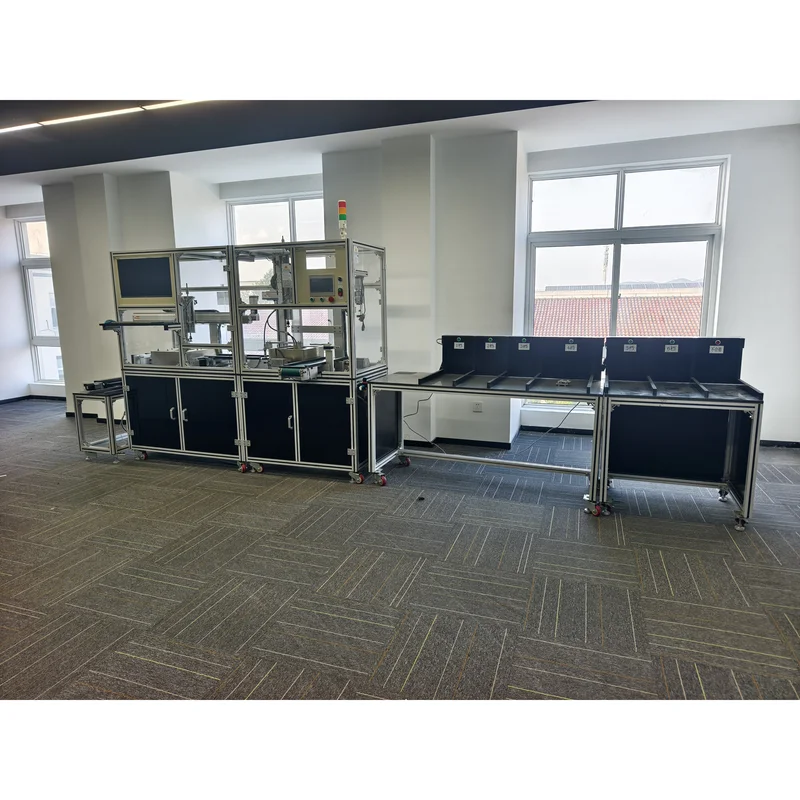
As volumes rise, automated magnetizing and testing systems take over the manual steps of presenting the part, firing the pulse and measuring the result. Automation’s contribution is not only labor savings; it is the removal of human variation from the process. A part presented the same way and magnetized by the same pulse produces the same result, cycle after cycle.
Automation also makes the measurement step practical at speed. Rather than sampling, the line can verify each part as it is produced, using the measurement instrument’s limit outputs to flag anything out of range. The measurement chain, often built around a fluxmeter such as the JH-T500 digital fluxmeter, becomes part of the control system rather than a separate inspection station.
Keeping the Process Stable
Long production runs test stability. Heat accumulates in coils and switching components, and a circuit that drifts thermally can drift in behavior. An industrial water chiller keeps the magnetizing system’s thermal conditions within their intended range, which supports both the repeatability of the pulse and the mechanical reliability of the fixture. Process discipline — scheduled checks of zeroing and drift on the measurement side, periodic re-verification of the fixture on the tooling side — keeps the whole chain from drifting together.
Planning a Magnetization Program
A motor manufacturer approaching magnetization as a program, rather than as a purchase, tends to work through the same steps:
- Define the magnetization requirement from the motor design — pole pattern, orientation, material and magnet mass.
- Choose a magnetizing platform capable of delivering the required field with margin.
- Develop a fixture that reproduces the pattern on the actual part.
- Decide where magnetization sits in the production sequence and how parts are handled afterwards.
- Specify the measurement method and the acceptance criteria for each part.
- Integrate cooling and any automation needed for the required pace.
- Document the process so it can be audited and improved.
The solutions approach is built around this sequence, treating the equipment, fixture, cooling and measurement as one system. Background on how the equipment works is available in the industrial magnetizing machine guide, and company credentials and history are on the about page.
FAQ
When should magnetization be planned into a motor program?
From the beginning. Magnet geometry, assembly sequence and handling all constrain the magnetization step, so leaving it until the end limits what can be achieved and often forces compromises elsewhere.
Can one magnetizing system serve an entire motor family?
Often the same platform can serve several parts by changing fixtures and settings, but parts with very different materials or magnet masses may call for different design classes. The range is organized so that the platform can be matched to a demanding part in the program.
How does a manufacturer prove magnetization was done correctly?
By measuring it. Flux measurement with an instrument such as the JH-T500 digital fluxmeter confirms the result for each part, and in automated lines its limit outputs can identify out-of-range parts automatically.
Why is cooling part of a production magnetization specification?
Because repeated pulsing heats the coil and switching components, and a system outside its intended thermal range can behave inconsistently. Cooling keeps the pulse — and therefore the product — stable over a long run.
Does automation change the magnetization itself?
Automation does not change the physics, but it removes variation from how the part is presented and how the result is checked. In practice that is what makes the process reliable at production scale.
Where to Start
Permanent magnet motor manufacturing rewards a magnetization process that is designed, matched, cooled, automated where necessary, and verified. JHHS MAG builds impulse magnetizing systems, multipole and high-capacity platforms, custom fixtures and automated measurement systems for exactly this purpose, and supports customers through technical consultation, system design, manufacturing and commissioning. To discuss a motor program, reach the team through the contact page.
Website: https://jhhsmag.com/
Email: sales001@jhhsmag.com
WhatsApp: +86 18868929496
Location: Ningbo, Zhejiang, China