1500V / 2500V / 3000V Multipole Impulse Magnetizers
A multipole impulse magnetizer magnetizes several poles on a component in a single capacitor-discharge pulse. The pole pattern comes from the fixture, so a multipole impulse magnetizer is engineered as a set: the power supply provides the pulse, and the fixture distributes it into the pole layout your component needs. JHHS MAG builds both, and supplies the series in three voltage levels — 1500V, 2500V and 3000V — so a configuration can be matched to the component rather than the other way round.
What Multipole Magnetization Means
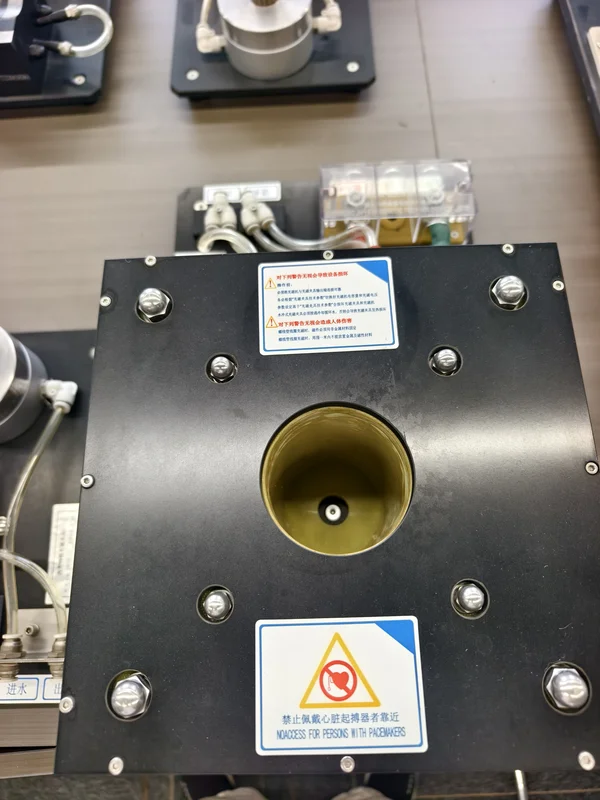
In multipole magnetization, the magnetizing fixture carries a set of pole pieces. When the pulse is discharged, each pole piece writes a separate pole into the magnetic material. The result is a component with a defined sequence of north and south poles around or along its surface — the pattern used in motor rotors, ring magnets, sensor magnets and speaker magnets.
Because the pole pattern is a property of the fixture, changing the pattern means changing the fixture, not the power supply. This is what allows a single multipole machine to serve several different components over its working life.
Flat and Radial Multipole Configurations
Multipole fixtures are built in two families:
- Flat multipole fixtures — used where the poles are written across a flat face, such as arc segments and planar assemblies
- Radial multipole fixtures — used where the poles are arranged around the outside or inside of a ring or cylinder, including inner and outer radial arrangements
Radial ring N/S fixtures are a related family, used for components such as speaker magnets and rotor rings where the north and south poles sit on opposite faces.
Key Capabilities
- Multipole magnetization of several poles on one component in a single capacitor-discharge pulse
- Flat multipole fixtures for pole patterns written across a flat face
- Radial multipole fixtures, including inner and outer radial arrangements, plus radial ring N/S fixtures
- Supplied at three voltage levels — 1500V, 2500V and 3000V — with the level matched to your component
- Magnetizing coils and fixtures built to the pole pattern, with coil cooling where the duty is continuous
Typical Applications
- Motor rotors — rotor magnetization to a defined multipole pattern
- Speaker magnets — radial ring magnetization for loudspeaker drivers
- Sensor and encoder magnets — precision pole patterns for magnetic sensing
- Ring and arc magnets — multipole magnetization before assembly into a device
The 1500V / 2500V / 3000V Series at a Glance
The JHHS MAG multipole series is supplied at three levels:
- 1500V — the entry level of the multipole series
- 2500V — the mid level
- 3000V — the top level of the multipole series
The right level for a given component is confirmed by our engineers once they see the part, the pole pattern and the target flux. Note that the 3000V Multipole Impulse Magnetizer and the 3000V Medium-to-High Capacity Impulse Magnetizer are different products: the multipole series is specified by pole pattern and pole count, while the medium-to-high capacity range is specified by magnetizing capacity. If your requirement is driven by capacity rather than pole layout, start from our medium-to-high capacity impulse magnetizers instead.
Matching Coils and Fixtures
Every multipole impulse magnetizer is delivered with components that match:
- Custom magnetizing coils built for the part and the pulse
- Multipole fixtures, flat or radial, built to the pole pattern
- Coil cooling where the application runs continuously
- Magnetic flux meters for verifying the pole pattern after magnetization
Share the component drawing, pole pattern and target flux, and we will propose the fixture design together with the magnetizing configuration.
Specifications
Detailed specifications depend on the machine configuration, the fixture and pole pattern, and the duty of the line.
Specifications vary by configuration — request the datasheet.
Related Product Categories
Other classes in the JHHS MAG impulse magnetizer range, and the systems they are commonly specified with.
Orientation Power Supplies
The controlled field applied while anisotropic powder is formed, so the easy axis follows the target direction.
→
Pulse Orientation Power Supply
A short high-intensity field pulse timed to the closing of the press or the mould.
→Demagnetizers
A decaying or alternating field that brings residual magnetism down to a workable level.
→
3000V Medium-to-High Capacity Impulse Magnetizers
Specified by magnetizing capacity for larger components and higher duty.
→
3500V / 4000V / 6000V Ultra-High-Energy Impulse Magnetizers
For magnetizing work that needs more energy per discharge.
→
1200V Impulse Magnetizers
Capacitor-discharge machines for magnetizing and demagnetizing your magnet in a single pulse.
→Request a Multipole Magnetizing Configuration
Send us your component drawing and pole pattern. We will come back with a multipole magnetizing configuration and a quotation.
Magnetizing Machine FAQs
How do I select a magnetizing machine for my application?
Selection starts with the magnet material and grade, component dimensions, magnetization pattern, and required production rate. The power supply and fixture must be evaluated together to provide the required field throughout the magnet. Send JHHS MAG your component drawing, material specification, and magnetic acceptance criteria for an application review.
Does a higher charging voltage always mean better magnetization?
No. Charging voltage is only one parameter. Capacitance, circuit resistance, fixture inductance, and coil geometry affect the current pulse and resulting magnetic field. A higher-voltage machine is not automatically the best choice; the configuration must suit the component and fixture.
Can magnets be magnetized after assembly into a rotor or another component?
Post-assembly magnetization may be possible, but it requires application-specific assessment. Magnet orientation, fixture access, surrounding steel, and conductive components can affect field distribution and penetration. Please provide an assembly drawing and identify the magnet material so that feasibility can be reviewed before equipment selection.
How should the magnetizing result be verified?
Verification should use agreed magnetic acceptance criteria, such as flux, magnetic moment, local flux density, or pole distribution. The measurement method and component position must be defined. Monitoring the discharge pulse helps control the process, but it does not replace measurement of the finished component.
Ready to discuss your magnetizing requirement?
Send us your component drawing, pole pattern and target magnetization. Our engineering team will reply with a configuration proposal and a quotation.
REQUEST A QUOTE
Get a quotation for 1500V / 2500V / 3000V Multipole Impulse Magnetizers
Tell us about your component, magnet material and production target. Our engineers review the requirement and reply with technical feasibility and a quotation.
- Reviewed by our own engineers, not a sales desk
- Send drawings, samples or a reference part
- No obligation — we quote only what fits your process
Prefer to talk it through? WhatsApp +86 188 6892 9496
Frequently asked questions
What information do you need to quote a magnetizing system?
Pole count, pole pitch, part diameter, magnet grade, flux target and cycle time decide both the fixture and the energy level. Send those with the drawing and the 3000V multipole class is specified around them.
Can the coil or fixture be designed around our component?
Yes. Multipole tooling is built around pole pitch and diameter, so spacing stays even right around the circumference instead of varying from pole to pole.
Are the power supply, coil and fixture supplied as one system?
Supply and tooling are specified as a pair; the energy level follows from the pole pattern and the section thickness, not from a standalone rating.
How do we start an inquiry?
Use the form on this page, write to sales001@jhhsmag.com, or send a sample. You get a technical assessment and a quotation back.