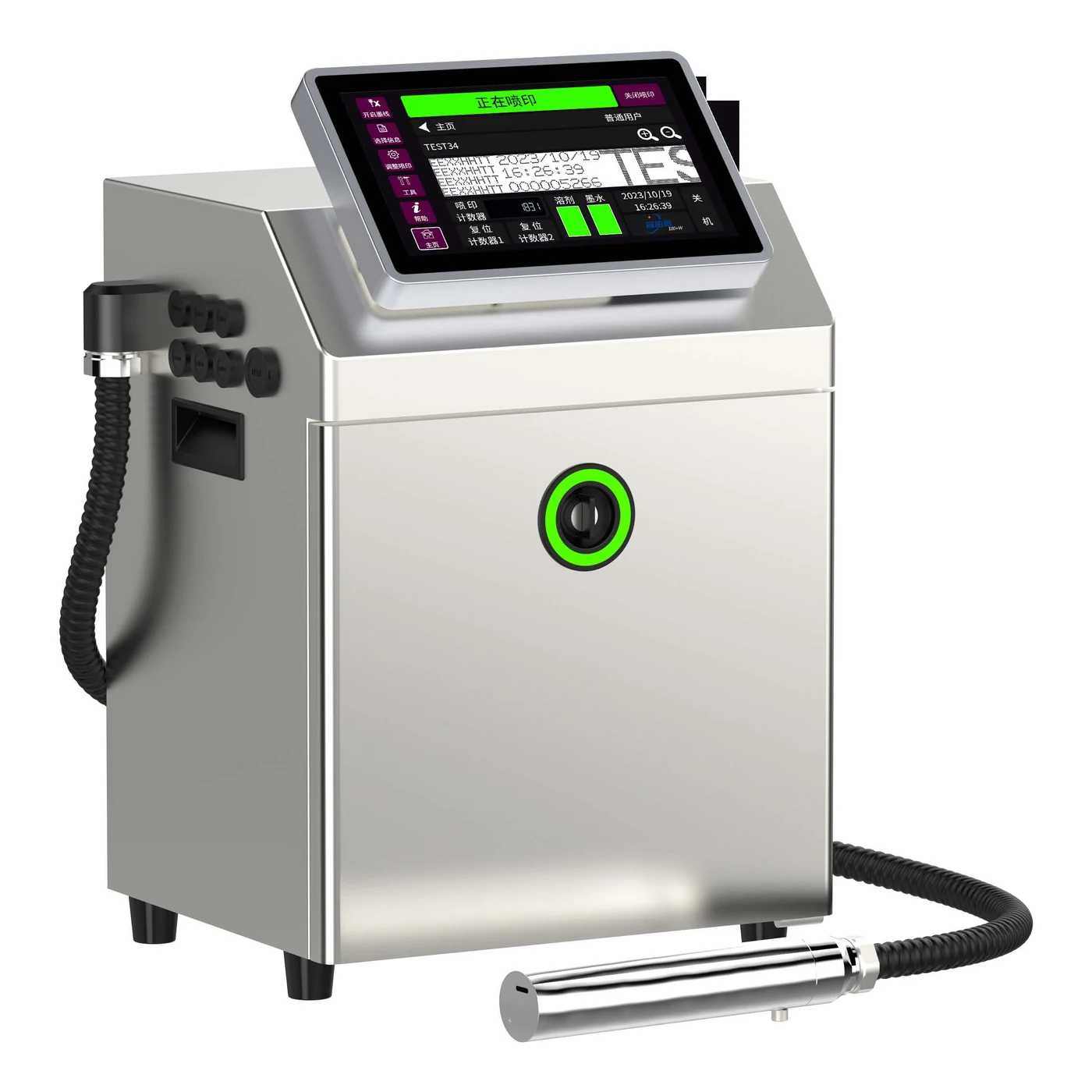
100+W Small Character Inkjet Printer
The 100+W is the pigment ink model of the 100 series. It runs white, yellow-white and blue-white pigment inks for a light code on dark and light-absorbing surfaces, with a character height of 2–10 mm selected by font dot matrix and an optimum print distance of 12 mm.
Why Pigment Ink, Not Solvent
A solvent ink carries its colour as a dye dissolved in a fast-evaporating carrier. On a white carton or a paper label the dye reads clearly, because the surface behind the code reflects light back through it. On a dark or light-absorbing surface there is little light coming back from underneath, so the same code loses contrast and the operator has to stop and look twice.
A pigment ink works the other way round. It carries solid colour particles in white, yellow-white and blue-white, so the code is visible because of the ink itself rather than because of what lies beneath it. That is the essential difference between the 100+W and the 100+H: both are small character inkjet printers built on the same continuous inkjet print platform, with the same heated print module, the same ink circuit architecture and the same stainless steel cabinet, but the 100+W is the version specified for pigment inks in white, yellow-white and blue-white, and the 100+H is specified for standard solvent inks.
Because the platform is shared, the choice between the two is a question of ink and substrate, not of machine quality. The print module, the nozzle heater, the simplified ink circuit, the viscosity control and the message editor are common to both.
Where the 100+W Fits on a Line
Use the 100+W where the code has to be readable at a glance on a dark surface: dark moulded plastics, dark cable and wire jackets, black cartons, black film and black packaging, where a solvent code would sink into the background. The same head also covers light surfaces that absorb ink and dull a dye-based code, such as uncoated board and moulded parts with a matt finish.
Character height is 2–10 mm, selected by font dot matrix, so one printer can carry a small date and batch block on a small component and a larger code on the case or the outer packaging. The optimum print distance is 12 mm, with a working range of 5–20 mm, which covers the stand-off normally needed between the print head and a moving product.
The cabinet is IP65 stainless steel, 540 × 391 × 337 mm (H × W × D), 17 kg unpacked, so the printer can be mounted beside a wash-down area instead of in a separate dry room. The standard scope is one printer and two M12 4-pin plugs, which keeps the electrical interface to a single connection point on the line.
Specifications
| Ink type | Pigment inks in white, yellow-white and blue-white |
|---|---|
| Character height | 2–10 mm, selected by font dot matrix |
| Print distance | Optimum 12 mm · range 5–20 mm |
| Cabinet | IP65 · stainless steel cabinet |
| Weight, unpacked | 17 kg |
| Cabinet dimensions (H × W × D) | 540 × 391 × 337 mm |
| Ink circuit | Sleep-mode ink circuit circulation with viscosity control while asleep |
| Standard scope | 1 printer, 2 × M12 4-pin plugs |
Figures above are the differences between the 100+W and the 100+H on the shared 100 series platform. Everything else on the machine is common to both models and is listed in the next section.
Shared Print Platform
The 100+W is built on the same print platform as the rest of the 100 series, so the service routine, the spare parts and the operating logic are the same across the range.
- Heated print module with nozzle heater, so the ink is held at printing temperature before it reaches the nozzle.
- Simplified ink circuit: service-free filter assemblies, quick couplings and an integrated nozzle filter, which reduces the number of joints in the ink path.
- Solvent economy with a condenser: one solvent cartridge lasts up to 130 hours.
- Viscosity control that is physically measured, not inferred from running hours.
- Dynamic calibration across an ambient range of −30 °C to 60 °C.
- Consumables policy: ink supplied open or encrypted, solvent cartridge with chip.
- Three-colour alarm light for at-a-glance status from across the line.
- One-key shutdown, so the printer can be stopped and parked in a single action at the end of a shift.
- External print head valve and a large recovery valve in the valve module.
- Built-in graphic editor for text, graphics, 1D and 2D barcodes and random codes.
- Internal storage for unlimited messages, so a full product list can live on the printer.
- Connectivity: RS232, RJ45, USB, rotary encoder input, print trigger and status output, with an optional IoT module.
What It Marks
The built-in graphic editor builds the message on the printer itself: dates, batch and lot numbers, serial numbers, 1D and 2D barcodes and graphics can sit in one layout, and random codes can be generated in the message rather than supplied from a host system. Because internal storage holds unlimited messages, a line that runs several products can recall the right layout by name instead of editing it at changeover.
On a dark substrate the practical use is a white or light code that stays readable in plant lighting and under a handheld scanner: an expiry date on a black carton, a lot code on a dark moulded housing, a serial number on a black cable jacket, or a 2D code on a dark label that has to be read by a fixed camera downstream. The rotary encoder input keeps the code position tied to the line speed, and the print trigger lets the code be placed from a product sensor rather than by hand.
100+W or 100+H?
The decision comes down to two questions: what the code sits on, and how tall the characters have to be.
If the code lands on a dark, light-absorbing or matt surface — dark plastics, dark cable jackets, black packaging, uncoated board that dulls a dye — the substrate is the constraint, and the 100+W with white, yellow-white or blue-white pigment ink is the model that solves it. Character height on the 100+W runs from 2 to 10 mm, selected by font dot matrix, which is the range most date, lot and serial codes fall into.
If the code lands on a light carton or a label where a standard solvent ink already reads, and the application needs taller characters than the pigment range offers, the 100+H small character inkjet printer is the model specified for standard solvent inks. Both machines share the same cabinet, the same print platform and the same message editor, so the operating routine on the line does not change when the two sit side by side.
Where a plant runs both light and dark packaging on the same site, the usual arrangement is one 100+H for the light cases and one 100+W for the dark product, with the same message structure on both. Send us the substrate and a sample code and we will confirm which of the two fits before anything is ordered.
Frequently Asked Questions
Questions from packaging and cable plants about pigment ink, character height and the choice between the 100+W and the 100+H.
What is the difference between the 100+W and the 100+H?
They are the same small character inkjet printer platform with a different ink specification. The 100+W runs pigment inks in white, yellow-white and blue-white, which is what produces a light, high-contrast code on dark and light-absorbing surfaces. Its character height is 2–10 mm, selected by font dot matrix, with an optimum print distance of 12 mm and a range of 5–20 mm. The 100+H is the version specified for standard solvent inks.
Will a white code hold up on dark plastic and black packaging?
That is what the pigment inks are for. White, yellow-white and blue-white pigment inks are intended for dark plastics, dark cable jackets and black packaging, where a dye-based solvent ink would lose contrast. The cabinet is IP65 stainless steel, so the printer can also be mounted beside a wash-down area rather than in a separate dry room.
What happens to the ink circuit when the printer is idle?
The ink circuit circulates in sleep mode with viscosity control while asleep, and viscosity is physically measured rather than assumed. Solvent consumption is kept down by the condenser, with one solvent cartridge lasting up to 130 hours. At the end of a shift the printer is parked with one-key shutdown.
What can the 100+W print and how does it connect to the line?
The built-in graphic editor handles text, graphics, 1D and 2D barcodes and random codes, and internal storage holds unlimited messages. Connectivity covers RS232, RJ45, USB, a rotary encoder input, a print trigger and a status output, with an optional IoT module. The standard scope is one printer and two M12 4-pin plugs.
Need a white code on a dark surface?
Send us the substrate, the line speed and the code content. We will confirm the ink, the dot matrix and the print distance, and come back with a configuration proposal.
REQUEST A QUOTE
Get a quotation for 100+W Small Character Inkjet Printer
Tell us what has to be marked, on which material, at what line speed and in what ink colour. Our engineers review the requirement and reply with a technical proposal and a quotation.
- Reviewed by our own engineers, not a sales desk
- Send a sample product, the line speed and the code content
- No obligation — we quote only what fits your line
Prefer to talk it through? WhatsApp +86 188 6892 9496