Water-Cooled Solenoid Coils
A water-cooled solenoid coil is a magnetizing winding with its own cooling circuit, built for stations that run continuously.
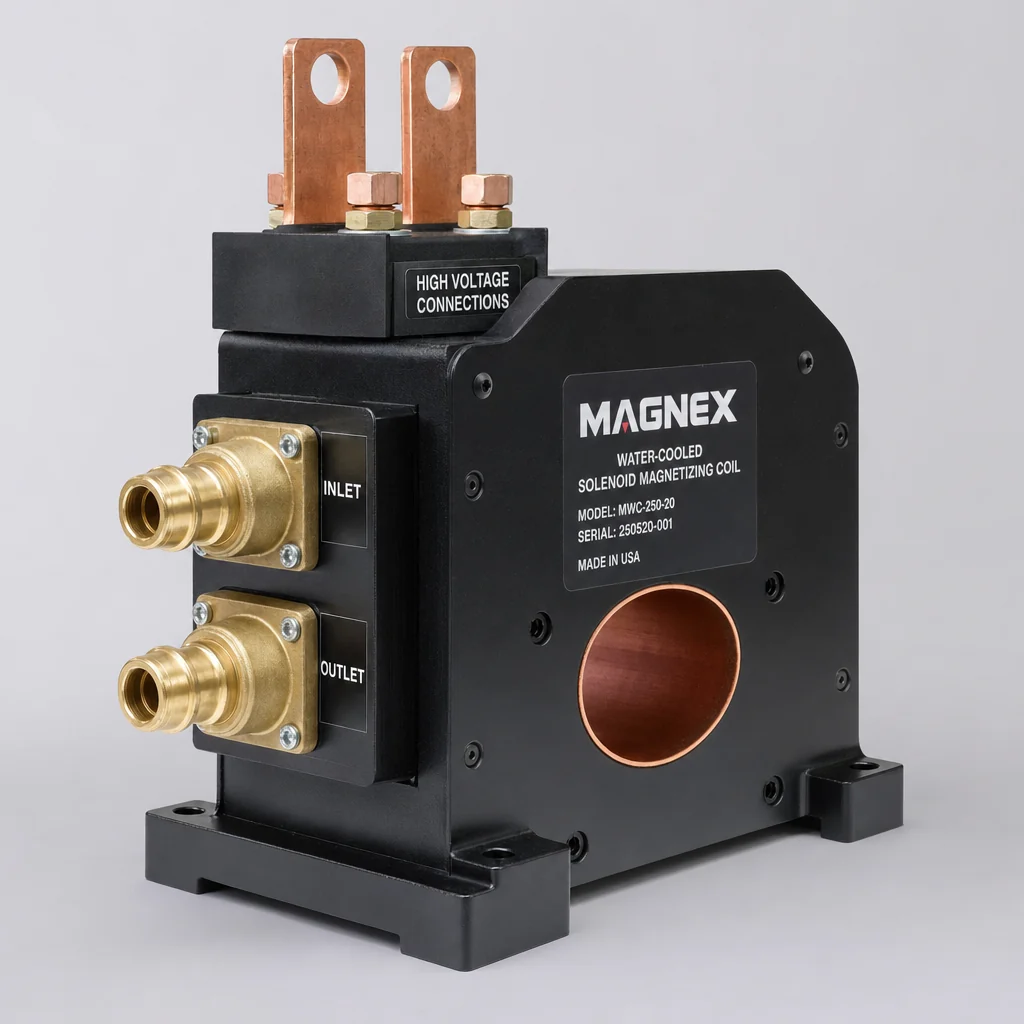
What a Water-Cooled Solenoid Coil Is
A water-cooled solenoid coil is a magnetizing winding built as a solenoid around a bore, with a cooling circuit arranged inside or alongside the winding so that heat is taken out of the coil while it works. The component to be magnetized is loaded into the bore, and the pulse passes through the winding in the direction that produces the required magnetization in the part. This assembly is also what buyers mean by a water-cooled magnetizing coil: the cooling circuit, not the coil geometry, is what lets it run continuously at production rate.
Because the winding carries repeated discharges in production, the current heats the conductor, and without a cooling path that heat accumulates until the insulation and the dimensional stability of the coil are affected. A cooling circuit therefore runs through the assembly, and the cooling medium is circulated through it while the station is working.
Water-cooled coils are used where a magnetizing station runs continuously, where the components are large enough that each pulse puts a substantial amount of energy into the winding, or where a short cycle time has to be held without the coil drifting out of specification.
What This Coil Does
- Provides the solenoid winding that the component is loaded into for magnetizing
- Carries the pulse through the winding in the direction that produces the required magnetization
- Removes the heat generated by repeated discharges, so the winding stays within its design temperature
- Keeps the bore and the winding aligned so the component is magnetized the same way on each cycle
- Provides the fluid connections, insulation and mounting points that the magnetizing station needs
Design Considerations
- Tooling geometry — bore diameter, winding length and the space around the conductor decide how the field couples into the component.
- Cooling circuit — the path of the coolant through the assembly is arranged so heat is taken from the winding rather than from the part being magnetized.
- Insulation — conductor insulation, lead insulation and the barrier to the cooling circuit are specified for the pulse and for the working temperature.
- Location and repeatability — a bore that locates the component and a mounting that locates the coil keep the process repeatable.
- Durability — the winding, the electrical joints and the cooling connections are the parts that wear, so they are designed for service and replacement.
Compatible Equipment
A magnetizing fixture or coil is one part of a complete setup, so it is specified together with the equipment that supplies the pulse, removes the heat and confirms the result.
Related Fixture Types
Other fixture arrangements built for different component geometries and pole patterns:
Request a Water-Cooled Solenoid Coil
Tell us the component that has to fit inside the bore, the duty of the station and how the coil will be cooled. Our engineers will propose a coil design and a quotation.
Ready to discuss your magnetizing requirement?
Send us your component drawing, pole pattern and target magnetization. Our engineering team will reply with a configuration proposal and a quotation.
REQUEST A QUOTE
Get a quotation for Water-Cooled Solenoid Coils
Tell us about your component, magnet material and production target. Our engineers review the requirement and reply with technical feasibility and a quotation.
- Reviewed by our own engineers, not a sales desk
- Send drawings, samples or a reference part
- No obligation — we quote only what fits your process
Prefer to talk it through? WhatsApp +86 188 6892 9496
Frequently asked questions
How is a magnetizing fixture designed?
From the pole pattern backwards: pole pitch sets the pole pieces, the part envelope sets the cavity, and the field depth you need sets conductor section and cooling.
Can one fixture cover several part numbers?
Where a family shares pole pattern and diameter, a common cavity with interchangeable inserts usually works. A different pole count almost always needs separate tooling.
What limits fixture life?
Arcing at the pole tips, insulation breakdown, and wear at the locating faces. All three track cycle count rather than calendar age.
How do we start?
Send the drawing with the pole pattern marked, the material grade, and the cycle time the line has to hold.