Axial Magnetizing Fixtures
Axial fixtures drive the pulse along the axis of the part, so the poles appear on its flat faces and the flux runs through its thickness.
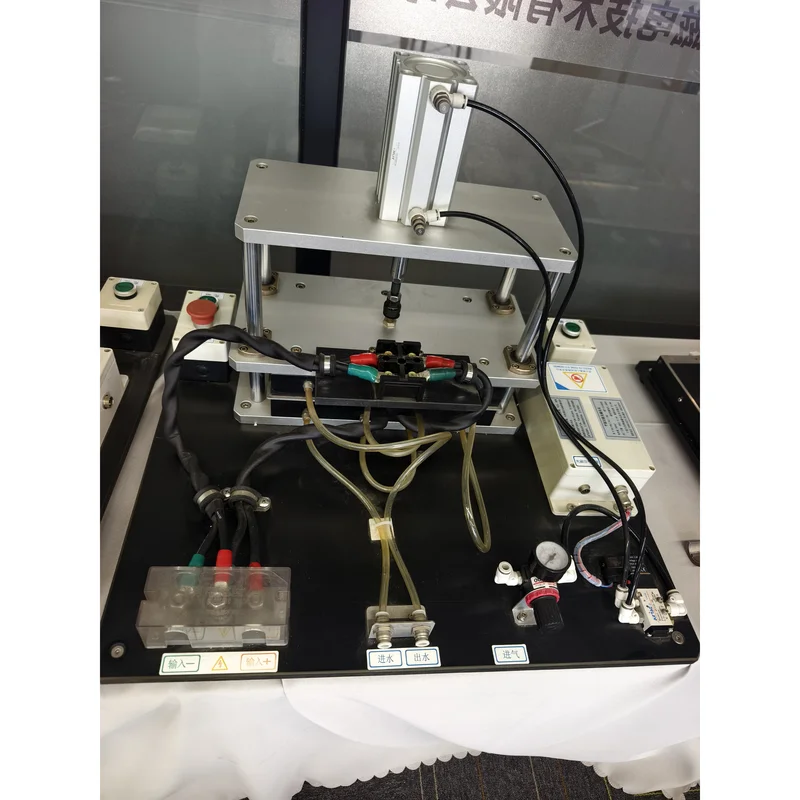
What an Axial Fixture Is
An axial magnetizing fixture applies the magnetizing pulse along the axis of the component, so the poles emerge on the flat faces of the part and the flux runs through its thickness. The workpiece is normally loaded between pole pieces, platens or a clamping plate, and the fixture presses it flat so that the face being magnetized stays square to the direction of the field.
Axial fixturing is the arrangement used for disc magnets, flat rings, arc segments, plates and any component whose magnetization is defined perpendicular to a face rather than around a circumference. Because the pulse has to pass through the full thickness of the part, the pole pieces and the clamping surfaces need to close the magnetic circuit efficiently and to locate the component accurately in the plane of the face.
The fixture therefore combines the winding or pole structure with a locating and clamping system, and it is built around the geometry of the component that has to be magnetized.
What This Fixture Does
- Applies the pulse along the axis of the component, so the poles sit on the flat faces of the part
- Presses and holds the component flat between pole pieces or platens while the discharge is applied
- Sets the pole pattern and its position relative to the edges and features of the part
- Locates the component in the plane of the face so the pattern repeats from part to part
- Can be built as a single-sided or double-sided arrangement, depending on how the poles have to be distributed
Design Considerations
- Tooling geometry — pole piece size, face flatness and the gap at the working position decide how the field couples into the component.
- Insulation — windings, leads and the adjacent metalwork are insulated for the pulse and for the handling the fixture sees in production.
- Location and repeatability — edge stops, dowels or a locating plate keep every component in the same position and orientation.
- Heat removal — clamping plates and pole pieces conduct heat away from the winding where the fixture runs continuously.
- Durability — contact faces wear with every cycle, so replaceable wear surfaces and access for service are designed in.
Compatible Equipment
A magnetizing fixture or coil is one part of a complete setup, so it is specified together with the equipment that supplies the pulse, removes the heat and confirms the result.
Related Fixture Types
Other fixture arrangements built for different component geometries and pole patterns:
Request an Axial Magnetizing Fixture
Send us the component drawing, the face that has to be magnetized and the pole pattern you need. Our engineers will propose a fixture design and a quotation.
Ready to discuss your magnetizing requirement?
Send us your component drawing, pole pattern and target magnetization. Our engineering team will reply with a configuration proposal and a quotation.
REQUEST A QUOTE
Get a quotation for Axial Magnetizing Fixtures
Tell us about your component, magnet material and production target. Our engineers review the requirement and reply with technical feasibility and a quotation.
- Reviewed by our own engineers, not a sales desk
- Send drawings, samples or a reference part
- No obligation — we quote only what fits your process
Prefer to talk it through? WhatsApp +86 188 6892 9496
Frequently asked questions
How is a magnetizing fixture designed?
From the pole pattern backwards: pole pitch sets the pole pieces, the part envelope sets the cavity, and the field depth you need sets conductor section and cooling.
Can one fixture cover several part numbers?
Where a family shares pole pattern and diameter, a common cavity with interchangeable inserts usually works. A different pole count almost always needs separate tooling.
What limits fixture life?
Arcing at the pole tips, insulation breakdown, and wear at the locating faces. All three track cycle count rather than calendar age.
How do we start?
Send the drawing with the pole pattern marked, the material grade, and the cycle time the line has to hold.