Permanent magnets reach their intended performance only after they are correctly magnetized. NdFeB (neodymium-iron-boron) and ferrite (ceramic) magnets are the two families commonly found in the rotors, sensors, actuators, pumps and small motors that customers bring to a magnetizing station, and the two families respond differently to the same process. Those differences affect the energy the system must deliver at the coil, the way a fixture is designed, and how the finished part is inspected. Understanding them before a fixture is built or a machine is specified is what keeps magnetization consistent and repeatable.
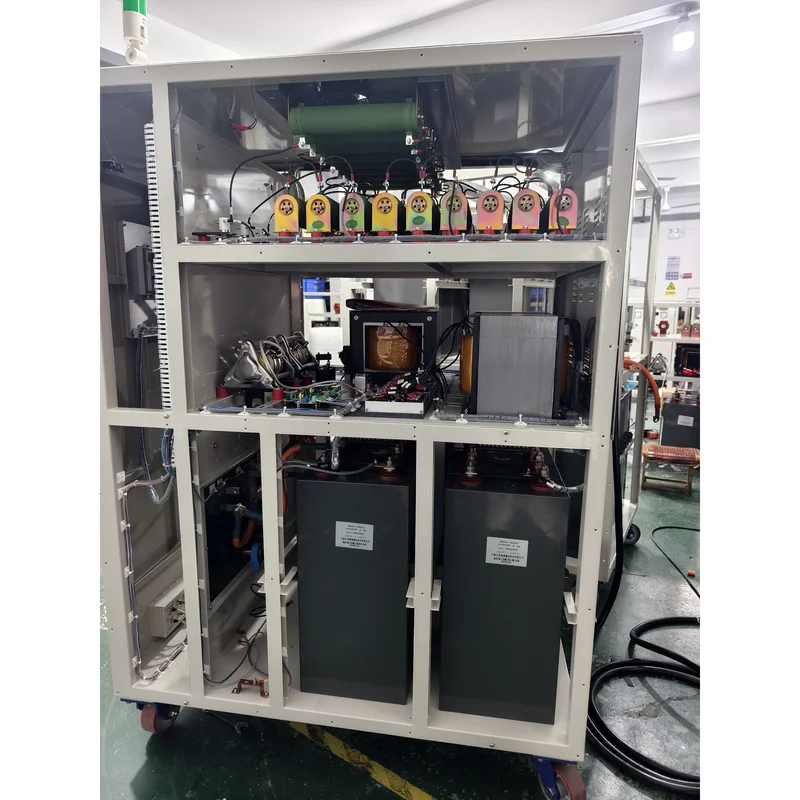
This article outlines the general engineering considerations for magnetizing both families. It describes how material behavior, part geometry and the surrounding equipment interact, and how an impulse magnetizer, a matched fixture and a flux meter work together on the production floor. It stays at the level of principle deliberately, because the right answer always depends on the specific part.
Key takeaways
- Coercivity, the material’s resistance to demagnetization, separates the families; NdFeB alloys are high-coercivity.
- High-coercivity NdFeB demands a stronger applied field to reach saturation, driving selection of higher-energy systems.
- Below the material’s threshold field, the magnet is only partially magnetized.
- Magnetization that is not measured is magnetization that is assumed; a fluxmeter closes the loop.
Why the Material Family Sets the Starting Point
Magnetization is the process of aligning magnetic domains inside a material so that their individual contributions add up in the same direction. How easily that alignment can be driven, and how firmly it is held afterwards, depends on the material family.
A useful general distinction is coercivity — the material’s resistance to demagnetization. NdFeB alloys are high-coercivity materials. Their domains resist being pushed into alignment, so the applied magnetizing field has to be strong enough to drive the material to saturation, and once saturated the magnet also resists being demagnetized by the fields it will meet in service. Ferrite is a lower-coercivity material. It aligns more readily and typically saturates under a comparatively less demanding applied field, but it is correspondingly easier to disturb later.
That single contrast — high coercivity versus lower coercivity — cascades through the whole process. It shapes how much magnetizing capability a system needs, how the fixture concentrates the field on the magnet, and how much process margin is available for repeatability.
Driving the Material to Saturation
For any material, the applied field during magnetization must exceed a threshold specific to that material and part. Below that threshold the magnet is only partially magnetized: it may look magnetized, but it will not deliver its full flux, and the shortfall may only appear later as a weak or inconsistent product.
High-coercivity NdFeB demands a stronger applied field to reach saturation, which is why NdFeB parts tend to drive the selection of higher-energy magnetizing systems. Lower-coercivity ferrite saturates under a less demanding field, which often makes it a more straightforward part to magnetize. The practical takeaway is directional rather than numeric: match the magnetizing capability of the system to the coercivity of the material, and always with margin, because the fixture and the part geometry consume part of the available field before it ever reaches the magnet.
Saturation is not only about peak field. It is also about providing that field uniformly enough that the entire magnet volume is swept, not just the region nearest the coil. A part that is saturated at the surface but not in its interior will fail in a way that is hard to diagnose from the outside.
Geometry, Orientation and Pole Pattern
Material is only half the challenge; geometry is the other half. A simple ring or block with a single magnetic orientation is comparatively easy to magnetize. The same material formed into a thin radial segment, a fine pole pitch, or a multipole ring is a different problem.
The following considerations apply to both NdFeB and ferrite:
- Orientation. Anisotropic materials have a preferred direction of magnetization. The magnetizing field must be aligned with that direction; misalignment wastes energy and produces a weaker magnet. Isotropic materials can be magnetized in more than one direction, which offers flexibility but often results in lower performance.
- Pole count and pitch. Multipole patterns concentrate the field into narrow regions. As poles get closer together, the fixture has to deliver a sharply localized field, which raises the demands on coil design and placement.
- Wall thickness and reach. The field must penetrate the whole section of the magnet. Thicker sections and deeper assemblies require a fixture that projects the field where it is needed.
- Assembly sequence. Some parts are magnetized before insertion into a rotor or housing, and some after. Magnetizing after assembly is often preferred when the surrounding structure would otherwise disturb alignment, but it places the magnet and the fixture in a tighter space.
In every case, NdFeB’s higher coercivity leaves less room for inefficiency in the fixture and the system than ferrite would.
Fixtures, Coils and the Rest of the System
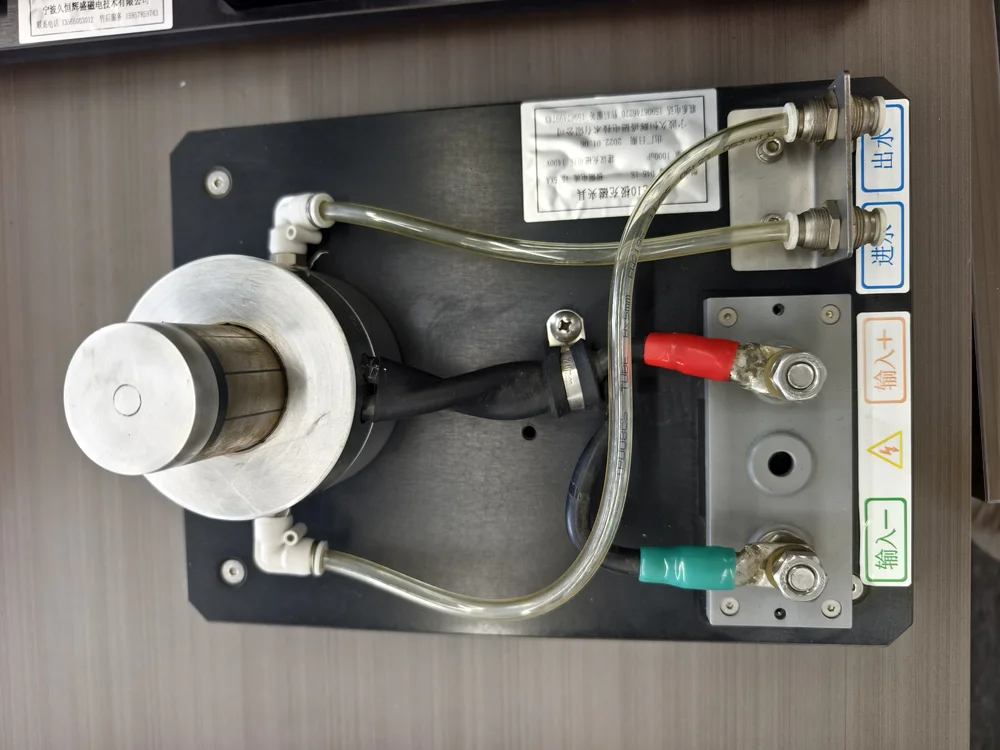
A magnetizer is only as good as the fixture that carries its field to the part. Custom magnetizing coils and fixtures are designed around the specific magnet geometry, orientation and pole pattern, so that the field arrives where the material needs it and is not dissipated elsewhere.
A complete magnetizing setup generally includes:
- A magnetizing power supply — the capacitor-discharge impulse magnetizer that stores energy and releases it as a pulse.
- A magnetizing coil or multipole fixture shaped to the part.
- Tooling that holds the part in a repeatable position relative to the coil.
- Cooling, where the duty cycle requires it, to keep the system stable across a production run.
- Inspection equipment to confirm that each part was actually magnetized as intended.
For NdFeB parts that must be driven hard to saturation, an ultra-high-energy impulse magnetizer paired with a purpose-built fixture is the usual basis. For ferrite parts, the same architecture applies with the field requirement calibrated to the lower coercivity of the material. The matching of energy, fixture and part is what makes the process repeatable; changing one element without re-validating the others is a common cause of drift in results.
Verifying the Result
Magnetization that is not measured is magnetization that is assumed. A digital fluxmeter closes the loop by confirming the flux produced in each part. A fluxmeter checks the outcome of the process rather than the process itself, so it catches the cases where a fixture has shifted, a part has moved, or a material lot behaves slightly differently.
Typical practice is to place the magnet in the coil, zero the instrument with the ADJUST control, withdraw the magnet from the coil, and read the flux directly. With the JH-T500 digital fluxmeter, the process uses six ranges, manual zeroing and manual drift adjustment, upper and lower limit settings with indicator-light outputs, and an RS232 connection for data transfer. Operators re-adjust the drift after changing ranges, connect the signal line to COIL INPUT with the black and red conductors interchangeable, and keep readings within the instrument’s working limit. Used consistently, this turns magnetization from an inspection by eye into a measured, repeatable step.
Process Discipline Across a Production Run
Consistency across a long run depends less on any single component and more on how the components are managed together. The following habits keep NdFeB and ferrite magnetization stable:
- Keep the fixture in good condition and re-verify it on a schedule.
- Fix the part position so that every cycle sees the same geometry.
- Manage heat so that long runs behave like short ones.
- Re-check drift and zeroing regularly, not only when a reading looks wrong.
- Record flux readings so that trends are visible before rejects appear.
An industrial water chiller that holds the fixture and switching components at a stable temperature supports the same goal: a pulse that behaves the same way on the first part and the thousandth.
FAQ
Can the same magnetizer magnetize both NdFeB and ferrite?
Often yes, but not necessarily at the same settings or with the same fixture. NdFeB’s higher coercivity generally requires more magnetizing capability than ferrite, so a system sized for NdFeB can usually handle ferrite jobs as well, while a system sized only for ferrite may not saturate NdFeB. The fixture is part-specific in either case.
Does a stronger magnetizer always produce a better magnet?
No. The goal is to reach full saturation, not to apply the maximum possible field. Beyond saturation, extra field adds stress to the part and the tooling without improving the magnet. Matching capability to the material is the point.
Why does the same material behave differently from one part to another?
Geometry, orientation, pole pattern and assembly position all change how the field reaches the magnet. Two parts made from the same material can require different fixtures and different pulse settings.
How do I know the magnet is fully magnetized?
Measure it. A fluxmeter reading taken immediately after magnetization shows the flux the part actually carries. Comparing that reading against an established value for the part tells you whether magnetization was complete.
Which material is easier to magnetize?
As a general rule, lower-coercivity ferrite aligns more readily than high-coercivity NdFeB. That does not make ferrite the “better” choice — each family has its own place — but it does mean the magnetizing step is less demanding for ferrite. See also re-magnetizing SmCo magnets inside a PEEK impeller.
Where to Start
The material family tells you how hard the magnet is to saturate; the geometry tells you how the field must be shaped; the equipment turns that into a repeatable process. NdFeB and ferrite each have their own considerations, but the underlying logic is the same — align the field with the orientation, drive the material fully to saturation, and measure the result. When you are ready to discuss a specific part, an ultra-high-energy impulse magnetizer and a custom fixture designed around your component are usually where the conversation starts. JHHS MAG can be reached through the contact page. More background is available in the industrial magnetizing machine guide. Other material and fixture guides sit on our magnetizing resources page.
Website: https://jhhsmag.com/
Email: sales001@jhhsmag.com
WhatsApp: +86 18868929496
Location: Ningbo, Zhejiang, China