Coding and Marking Machines
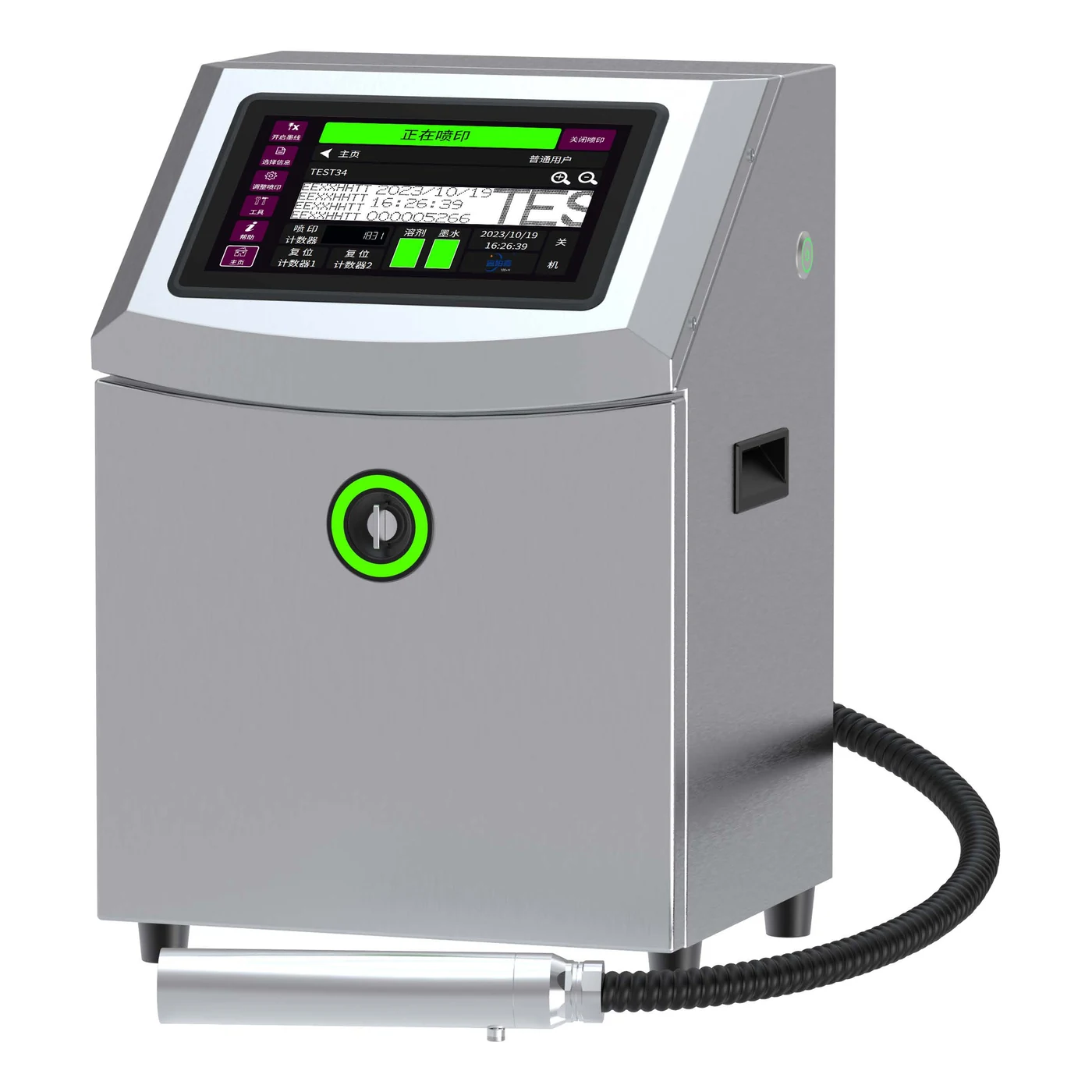
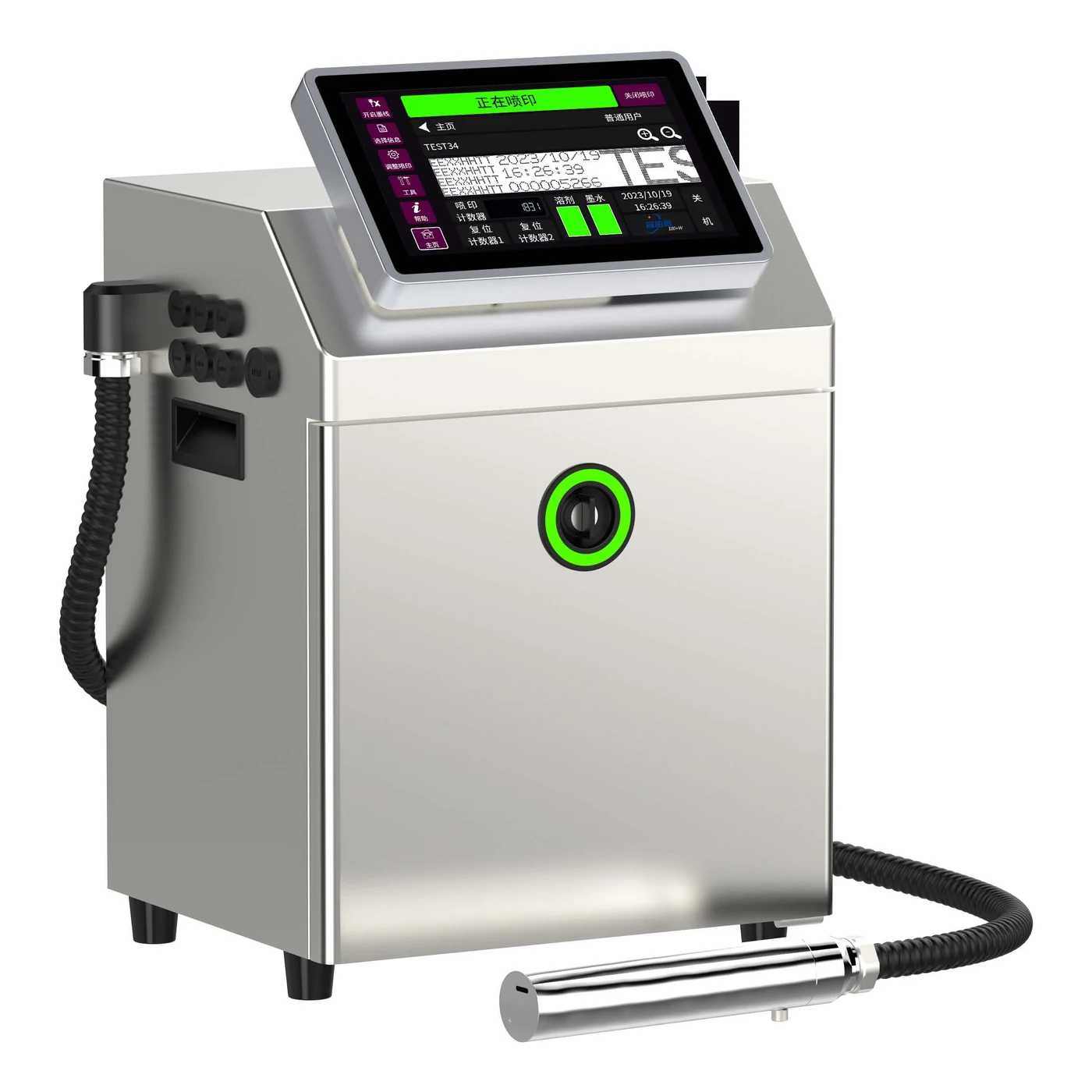
Marking is the step that gives a product its date, its batch number and its traceability code before it leaves the line. A small character inkjet printer writes those codes without touching the product, so it keeps pace with the line rather than interrupting it. The 100+H and the 100+W are continuous inkjet (CIJ) printers built for that duty, available from JHHS MAG in two ink configurations.
Coding Without Contact
A small character inkjet printer, also called a continuous inkjet (CIJ) printer, forms a stream of ink droplets and controls the formation of every single droplet so that the characters are written on the product as it passes the print head. Nothing touches the product and nothing is transferred from a plate, which is why this type of printer suits curved surfaces, recessed areas and fast-moving items that other marking methods cannot reach.
The print head is connected to the cabinet by a high-flexibility umbilical, so the head can be mounted on a bracket at the point where the mark has to appear while the ink system, the touchscreen and the controls stay in a position an operator can reach. Mark content is built on an internal graphic editor and stored in the machine, so a job can be recalled rather than retyped.
Both models share the same machine platform, the same 10.1-inch colour industrial touchscreen, the same print head and the same interface set. The difference between them is the ink system and the print envelope, which is what decides which one suits a given product.
Two Models, Two Ink Systems
The two models in this range are mechanically the same machine and are separated by the ink they are set up to run and the print envelope they cover. Choose by the substrate and by the size of the mark, not by the machine.
| Feature | 100+H | 100+W |
|---|---|---|
| Ink type | Standard solvent inks in black, red, blue and green | Pigment inks in white, yellow-white and blue-white |
| Character height | 2–20 mm, selected by font dot matrix | 2–10 mm, selected by font dot matrix |
| Print distance | Optimum 12 mm · range 3–30 mm | Optimum 12 mm · range 5–20 mm |
| Cabinet | IP65 · 304 stainless steel cabinet | IP65 · stainless steel cabinet |
| Weight, unpacked | 19.6 kg | 17 kg |
| Cabinet dimensions (H × W × D) | 511.5 × 386.5 × 349 mm | 540 × 391 × 337 mm |
| Ink circuit | Standard circuit | Sleep-mode ink circuit circulation with viscosity control while asleep |
| Standard scope | 1 printer, 1 × M12 4-pin plug | 1 printer, 2 × M12 4-pin plugs |
On a narrow screen the comparison table scrolls horizontally inside its container. The full specification of each model is on its own page.
What the Platform Provides
Both models are built on the same print and control platform, and the following points apply to either one.
- Heated print module. The print module is heated and controls the precise formation of every ink droplet, which is what keeps character quality even rather than variable across a run.
- Nozzle heater. The nozzle heater keeps the nozzle unaffected by high or low ambient temperature, so the printed result stays consistent when the shop floor is cold in winter or hot in summer.
- Simplified ink circuit. Service-free filter assemblies with quick couplings and an integrated nozzle filter make servicing easier and reduce secondary faults. The filters are not tied to a forced replacement interval.
- Solvent economy. With the condenser fitted, one solvent cartridge covers up to 130 hours of use, which lowers the running cost per thousand codes.
- Viscosity control. Viscosity is measured physically and independently rather than inferred, which raises the machine’s resistance to interference.
- Dynamic calibration. The calibration mechanism keeps the machine working normally across an ambient range of −30 °C to 60 °C.
- Consumables policy. Ink may be supplied open or encrypted, and the solvent cartridge carries a chip. Operators can change ink themselves without a service call.
- Status indication. A three-colour alarm light on the machine shows its working state at a glance from across the line.
- Quick shutdown. The one-key shutdown cycle cleans and closes the ink line and then switches the machine off by itself.
- Serviceable layout. The print head valve is mounted externally and the recovery valve is a large valve relocated to the valve module, so routine maintenance is faster.
- Mark editor. A built-in graphic editor produces text, graphics, 1D barcodes, 2D barcodes, random codes and special print effects.
- Storage. Internal storage behaves like a USB drive and holds an unlimited number of messages and user fields.
- Connectivity. RS232, RJ45, USB, a rotary encoder input, a print trigger and a status output are provided as standard, and an IoT module can be added for plant-level data collection.
What These Printers Mark
The mark content is not limited to plain text. Because the editor handles graphics, 1D barcodes, 2D barcodes and random codes, one printer can cover the whole coding requirement of a line rather than only the date field.
- Production and expiry dates, and time stamps down to the second
- Batch numbers, lot numbers and production order references
- Serial numbers and unique random codes for anti-counterfeiting and traceability
- 1D barcodes and 2D barcodes (QR codes) for scanning further down the line
- Logos, symbols, warnings and other fixed graphics
- Multi-line messages — up to five lines, with the available dot matrix sizes listed on each model page
Models in This Range
Each model page carries the full published specification, the features and the standard and optional scope of supply.
Marking Within a Production Line
A coder is rarely a machine on its own. It is one station in a sequence, and it is specified together with the handling and the inspection either side of it.
Automated Magnetic Material Processing
Marking, feeding, dispensing and sorting stations arranged as a production sequence.
→Automated Magnetizing and Magnetic Testing Systems
Magnetizing and per-part magnetic testing in one cycle, for lines that verify every part.
→All Product Categories
The complete range of magnetizing, cooling, measurement and production equipment.
→Request a Specification and a Quotation
Tell us what has to be marked, on which material, at what line speed and in what ink colour. We will come back with the model, the ink and the mounting arrangement that fit, together with a quotation.
Small Character Inkjet Printer FAQs
How do I choose a small character inkjet printer for my production line?
Start with the substrate, required code, character size, production speed, and available installation space. Also specify the number of print lines and any variable information, such as dates or batch numbers. For the JHHS MAG 100+H and 100+W, request a configuration review based on your actual coding requirement.
Can a small character inkjet printer print on plastic, metal, and glass?
Continuous inkjet technology is used on these materials, but suitability depends on the specific substrate, surface condition, ink, and printer configuration. Please identify the exact material or coating. Sample testing should confirm readability, drying, and adhesion under your production conditions.
How should ink adhesion and durability be evaluated?
Test the code on the actual product surface and allow the specified drying time before evaluation. The test should reflect what the code will experience, such as handling, abrasion, moisture, oils, or cleaning agents. An ink that performs well on one material may not perform equally well on another.
What determines the achievable printing speed?
Printing speed depends on the selected model and configuration, character matrix, number of lines, code length, and required print quality. Product movement and triggering also affect consistency. Provide your actual code and line speed so that performance can be evaluated for the intended application.
Related reading
Ready to discuss your marking requirement?
Send us the product, the surface, the line speed and the code content. Our engineering team will reply with a configuration proposal and a quotation.
REQUEST A QUOTE
Get a quotation for Coding and Marking Machines
Tell us what has to be marked, on which material, at what line speed and in what ink colour. Our engineers review the requirement and reply with a technical proposal and a quotation.
- Reviewed by our own engineers, not a sales desk
- Send a sample product, the line speed and the code content
- No obligation — we quote only what fits your line
Prefer to talk it through? WhatsApp +86 188 6892 9496
Frequently asked questions
What do the coding and marking machines do?
They print batch codes, dates and lot numbers onto parts or packaging, and are supplied from the same factory as the magnetizing range.
Which technology suits our line?
Continuous inkjet where speed matters on curved or uneven surfaces; laser or thermal transfer where the mark has to be permanent.
What about inks and consumables?
Solvent-based inks cover porous and non-porous substrates. Consumable supply is quoted together with the machine.
How do we choose a model?
From line speed, character height and substrate. Those three narrow the range before cost is discussed.