Magnetizing Solutions for Permanent Magnet Manufacturers
A permanent magnet producer magnetizes thousands of small blocks, rings and tiles and has to ship them at a defined flux level. JHHS MAG supplies the impulse power, the single post tooling and the flux check that keep that output even.
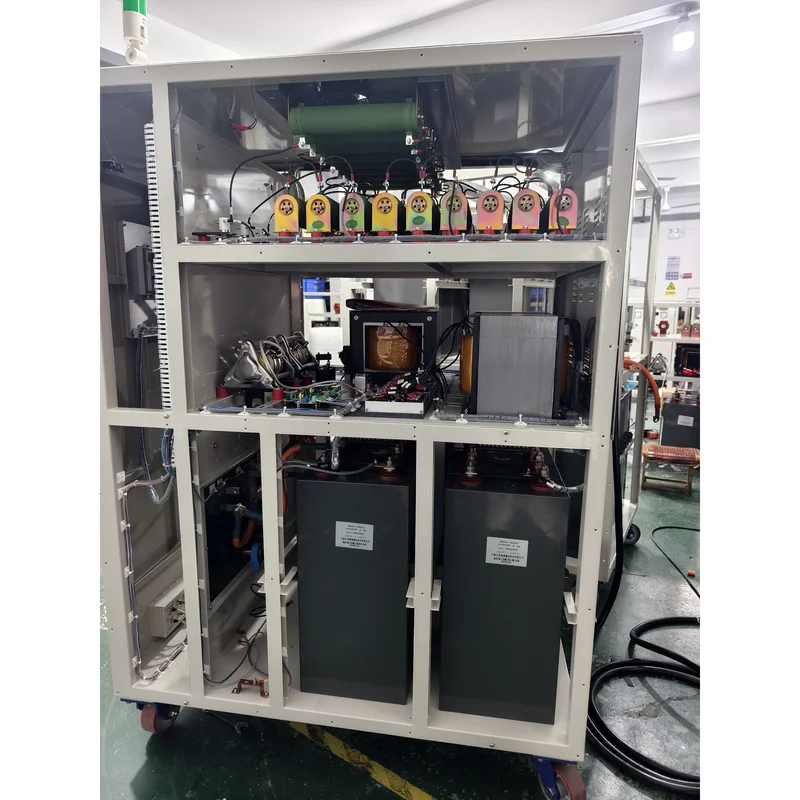
Where Magnetizing Sits in a Magnet Producer Process
A permanent magnet manufacturer turns sintered or bonded magnetic material into finished parts: blocks, discs, rings, arcs and tiles. Depending on the material and the grade, the parts may be supplied unmagnetized so that they can be ground, coated and cleaned without attracting swarf or clinging to one another. For sintered NdFeB the requirement is a permanent magnet magnetizer that reaches full saturation on every part, which is why these lines specify an NdFeB magnet magnetizer rather than a general-purpose unit. At production scale the same cell carries out magnet production line magnetization for the whole batch.
A final magnetizing pass therefore belongs late in the process. After grinding, coating and dimensional inspection the parts are magnetized and then checked, so the flux they leave the plant with is the flux the customer measures on receipt. For a producer running many small parts this step is less about one large workpiece and more about throughput, repeatability and separating the occasional weak part from the batch.
Sintering or bonding
Magnetic material is formed into near final blocks, rings or tiles.
Grinding, coating, inspection
Parts are finished to size and surface before any magnetizing takes place.
Magnetizing
Each part is magnetized through the intended axis on a single post station.
Flux check and sorting
Parts are compared against a reference and split into accepted and rejected batches.
Components and Magnet Grades Handled
A magnet producer usually runs several product families at once, and each family places a different demand on the magnetizing station.
Blocks, discs and tiles
Small NdFeB, SmCo or ferrite parts magnetized individually or in simple multiples before packing.
Sintered rings and arcs
Ring and arc magnets magnetized axially or radially, depending on how the field has to run through the part.
Bonded and moulded magnets
Parts where magnetic material is mixed into a binder and magnetized after the part has been formed.
Pre assembled magnetic parts
Magnets already glued into a carrier or housing that are magnetized once the assembly is complete.
Magnetization Requirements for Finished Magnets
The result a producer cares about is a part that is fully magnetized in the intended direction and that reads the same as the next part off the same line. Full magnetization means the applied field has to be strong enough to drive the material past its intrinsic coercivity, which is a property of the grade rather than of the shape, so a harder grade calls for a stronger applied field and the energy level and the coil are chosen together.
Direction matters as much as strength. A block magnetized through its thickness and the same block magnetized along its length are different products, and the tooling has to make the intended direction obvious to the operator. For rings and arcs the choice is often between a radial pattern and a multipole pattern, and each one needs its own fixture.
Because the parts leave the plant in large batches, repeatability is part of the requirement. The station is set once, the same setting is reused part after part, and the finished flux is compared against a reference, which is what turns a magnetizing operation into a controlled process rather than a one off.
- — f
- — d
- n — e
- l — u
Magnetizing Equipment for Magnet Producers
The equipment is matched to the part size and to the batch, so a producer with several product families is usually served by more than one configuration.
- 1200V impulse magnetizers — compact impulse power for small blocks, discs and tiles
- 3000V medium to high capacity impulse magnetizers — larger ring and arc magnets that need a deeper applied field
- Ultra high energy impulse magnetizers — high energy grades and multipole ring magnets
- Multipole impulse magnetizers — where a ring or arc has to carry several poles
- Products overview — the full magnetizing and testing range
Custom Coils and Fixtures for Magnet Production
A magnet producer rarely runs a single part, so the tooling is designed so that parts of different sizes and directions can be produced without rebuilding the whole station. A single post coil for blocks is kept simple and quick to load, while rings and arcs may need a multipole fixture or a water cooled solenoid that can hold the field across a larger volume.
Because the parts are small and numerous, the fixture is built so that a part sits in a repeatable position every time and, where the product allows, so that several parts can be magnetized in one discharge. The coil, the pole pieces and the cooling are specified together with the part that has to be magnetized.
Flux Testing and Sorting Options
Once a batch is magnetized the practical question is which parts are good. A fluxmeter used with a test coil gives a repeatable reading of the total flux of a part, which is compared against a reference so that parts outside the accepted range are separated before packing. For rings and multipole parts a field distribution check shows whether the pole pattern is even.
Where the volume justifies it, the magnetizing and the check can be brought together on one station, so the part is magnetized, measured and sorted in a single cycle and the reading stays tied to the part that produced it.
Frequently Asked Questions
Questions from magnet producers about magnetizing finished parts, running large batches and separating weak parts.
Does a magnet have to be magnetized after grinding and coating?
For many products, yes. Magnetizing after grinding, coating and inspection keeps unmagnetized parts easy to handle and avoids magnetic swarf clinging to the surface, and it places the magnetizing step just before the parts are checked and packed.
Can several small magnets be magnetized in one discharge?
Where the product and the fixture allow it, several small parts can be placed in one tool and magnetized together, which raises throughput for a producer who runs large volumes of small blocks, discs or tiles.
How is a weak part found in a batch?
The magnetized part is measured against a reference, usually with a fluxmeter and a test coil, and any part whose reading falls outside the accepted range is separated from the rest of the batch.
Does the magnet grade change the magnetizing equipment needed?
It does. A harder grade needs a stronger applied field to be fully magnetized, so the energy level and the coil or fixture are chosen together rather than from the part size alone.
Can one station produce axially and radially magnetized parts?
The power supply can serve more than one product, but the direction of magnetization is set by the tooling, so parts that need a different direction are produced with a different coil or fixture on the same station.
Discuss Your Magnetizing Project with Our Engineers
Send us the part, the magnet grade and the direction of magnetization you need. Our engineering team will reply with a configuration proposal and a quotation.
Ready to magnetize your magnet production?
Tell us the parts you produce and the flux you need them to carry. We will suggest the equipment and tooling that fit the volume.
REQUEST A QUOTE
Get a quotation for Magnetizing Solutions for Permanent Magnet Manufacturers
Tell us about your component, magnet material and production target. Our engineers review the requirement and reply with technical feasibility and a quotation.
- Reviewed by our own engineers, not a sales desk
- Send drawings, samples or a reference part
- No obligation — we quote only what fits your process
Prefer to talk it through? WhatsApp +86 188 6892 9496