Magnetic Field Camera
A magnetic field camera images the field across the whole surface of a magnet in one view, so the pole pattern of a multipole magnet can be seen and judged as a whole.
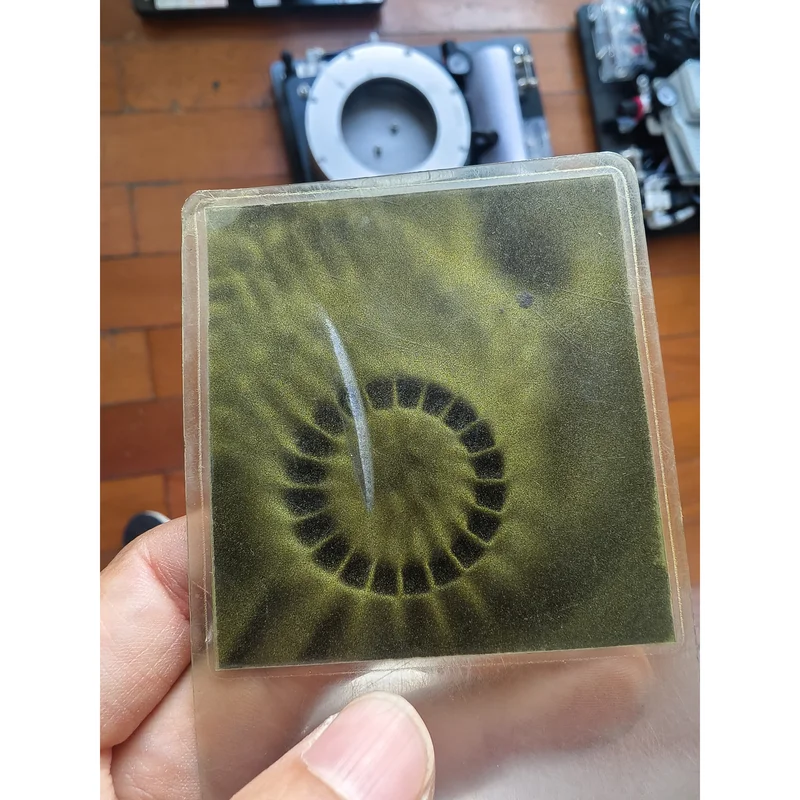
What a Magnetic Field Camera Does
A magnetic field camera images the field across the whole surface of a magnet at once, in the way a camera captures a picture, rather than sampling the field point by point. The result is a field image that shows how strong the field is and how it is directed over the entire face, so the arrangement of the poles can be seen as one picture.
This makes the camera well suited to multipole magnets, where what matters is a pattern rather than a single value. The image shows whether every pole is present, whether the poles are evenly strong and correctly placed, and whether the zones between them look as they should — points that are hard to judge from a series of separate readings.
The camera is used in development and in production for judging the quality of multipole magnets. In development it lets designs and magnetizing settings be compared against each other; in production a reference image gives every part the same standard to be judged against, which suits both design work and high-volume manufacture.
What It Does
- Images the field across the whole magnet surface at once, like a picture
- Shows the strength and the direction of the field over the full face
- Makes the pole pattern of a multipole magnet visible as a whole
- Reveals missing, weak or mis-placed poles that separate readings can miss
- Gives a reference image that parts in production can be judged against
Design Considerations
- Coverage and resolution — the field of view is chosen to take in the whole face, with enough detail to judge the pole pattern of the part.
- Pole pattern — the expected pole count and layout guide how the image is read, so an uneven result is easy to recognise.
- Positioning and fixturing — the part is held in a known place and orientation, so images from one part can be compared fairly with the next.
- Reference images — results are compared against a known-good image, so drift in the magnetizing process is detected early.
- Working environment — the distance to the surface and stray fields nearby are controlled, so the image shows the magnet and not the surroundings.
Compatible Equipment
A measurement or automation item is one part of a complete magnetizing and testing setup, so it is specified together with the equipment that produces, holds and cools the field, and with the machines that handle the parts.
- Magnetic field distribution testers — for mapping the field across a surface
- Multipole impulse magnetizers — the magnetizing source that sets the pole pattern
- Automated magnetizing and testing systems — where field inspection runs in line
- Custom magnetizing coils and fixtures — the tooling that defines the pole layout
- Magnetic fluxmeters — for total flux measurement alongside a field image
Related Pages
Other pages in this group:
Discuss Your Field Imaging Requirement
Tell us the part, the pole pattern you expect and where the check has to happen. Our engineers will suggest an imaging setup that fits the job.
Ready to image the field on your magnets?
Send us the part and the pole pattern you need to confirm. Our engineering team will reply with a proposal and a quotation.
REQUEST A QUOTE
Get a quotation for Magnetic Field Camera
Tell us about your component, magnet material and production target. Our engineers review the requirement and reply with technical feasibility and a quotation.
- Reviewed by our own engineers, not a sales desk
- Send drawings, samples or a reference part
- No obligation — we quote only what fits your process
Prefer to talk it through? WhatsApp +86 188 6892 9496
Frequently asked questions
What does a magnetic field camera show?
The field across an entire face in a single acquisition — pole positions, transitions and dead spots — instead of a series of point readings.
When is it better than scanning with a Hall probe?
When the pattern matters more than the number. A scan traces lines; a camera shows whether the whole pattern is even across the surface.
Can it check multipole rings?
Yes, with a fixture that presents the circumference to the sensor array, so every pole is captured in one acquisition rather than stitched from several.
What resolution do we need?
It follows from the smallest feature you must resolve — a transition edge or a narrow pole. State that dimension and the sensor pitch follows from it.