Orientation Power Supplies
Orientation power supplies create the controlled field that aligns anisotropic magnetic powder while a magnet is being formed, so the easy axis of the material ends up in the direction the application needs.
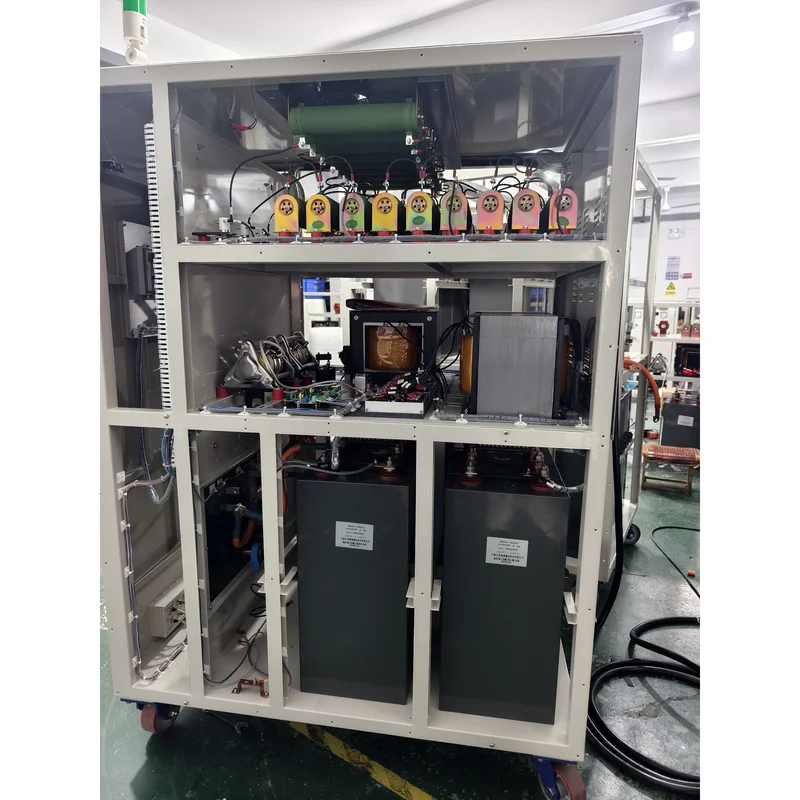
What Orientation Power Supplies Do
An orientation power supply provides the controlled magnetic field that is applied while an anisotropic magnetic material is being formed. Anisotropic powder only develops its full magnetic potential along one preferred direction — the easy axis — and that direction has to be fixed during pressing, sintering, injection moulding or calendering, before the binder or the sintered structure locks the particles in place.
The supply therefore works together with the press, the mould or the die rather than as a stand-alone machine. Depending on how the forming process runs, the field can be delivered either as a short high-intensity pulse that is synchronised with the closing of the tool, or as a steady field that is held for the whole forming cycle. In both cases the job of the supply is to establish a known field direction at the moment when the material is still able to move.
Typical work is wet-pressed anisotropic ferrite, injection-moulded or calendered bonded magnets, and rubber magnets, where the alignment achieved during forming decides how much flux the finished part will deliver later.
What It Does
- Creates a controlled magnetic field at the forming station while the part is still shapeable
- Aligns the easy axis of anisotropic powder with the direction the finished magnet has to carry
- Works together with the press, mould or die so the field is present at the right moment in the cycle
- Can be arranged as a synchronised pulse or as a steady field, according to how the process runs
- Keeps the field direction the same from one part to the next so the alignment of the batch stays consistent
Design Considerations
- Tooling geometry — the coil or pole structure has to fit around the die and the cavity, so the layout of the tool decides how the field reaches the powder.
- Field direction — the orientation axis follows the intended magnetization of the finished part, so the coil, the die and the loading direction are planned together.
- Cycle synchronisation — the field has to be present while the material can still move, which ties the supply to the timing of the press or the mould.
- Insulation and safety — conductors, leads and the guarding around the forming station are specified for the supply and for operators working at the machine.
- Heat and durability — repeated cycles warm the winding, so cooling and access for service are designed in where the station runs continuously.
Compatible Equipment
An orientation power supply is one part of a complete forming and magnetizing setup, so it is specified together with the equipment that supplies the field, removes the heat and confirms the result.
Related Pages
Other pages in this group:
Discuss Your Orientation Requirement
Tell us the material, the forming process and the direction the powder has to be aligned in. Our engineers will propose a supply configuration and a quotation.
Ready to discuss your orientation requirement?
Send us your component drawing, the forming process and the target orientation. Our engineering team will reply with a configuration proposal and a quotation.
REQUEST A QUOTE
Get a quotation for Orientation Power Supplies
Tell us about your component, magnet material and production target. Our engineers review the requirement and reply with technical feasibility and a quotation.
- Reviewed by our own engineers, not a sales desk
- Send drawings, samples or a reference part
- No obligation — we quote only what fits your process
Prefer to talk it through? WhatsApp +86 188 6892 9496
Frequently asked questions
What is an orientation power supply used for?
It holds a steady field while anisotropic powder is pressed or cast, so the easy axis of the material lines up with the direction you want.
How does it differ from a magnetizer?
It runs continuously at a lower field instead of discharging a pulse. Orientation happens during forming; magnetization comes later.
Which materials need orientation?
Anisotropic ferrite and bonded NdFeB, where the powder has to be aligned before it is consolidated.
What has to be specified?
The field strength at the die, the pole gap, the duty cycle and the cooling, because the coil runs hot for long periods.